Chapter 07 · 1928 to the present

The life afterthe life

Ram Prasad Bismil was thirty when he died and largely unknown outside the United Provinces. Almost everything that made him a national figure happened afterwards — and that afterlife has a history of its own.

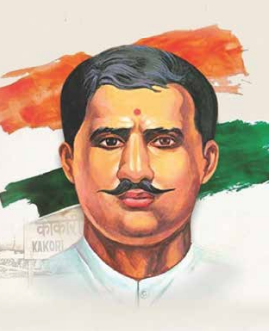
Contemporary illustrated portrait of Ram Prasad Bismil in front of saffron, white and green brushstrokes, with a small Kakori railway signboard visible at the lower left.
What this is
A present-day commemorative illustration, painted long after Bismil's death.
Why it belongs here
The tricolour ground and the Kakori signboard are not historical detail. They are the visual shorthand through which India now remembers him — which makes this image evidence about the twenty-first century, not the twentieth.

First inheritance

The book that outlived the author

The single most consequential thing Bismil left was a manuscript. Written in the condemned cell at Gorakhpur during 1927 and carried out of the jail in instalments, it was published in 1928 by Ganesh Shankar Vidyarthi from the Pratap Press at Cawnpore, under the cover title Kakori ke Shaheed.

The choice of publisher mattered. Vidyarthi was among the most significant nationalist editors in northern India, and the Pratap Press had both the distribution and the willingness to take the risk. Publishing the memoir of an executed revolutionary was not a neutral act, and it was not treated as one.

The colonial administration's response is the clearest available measure of what it thought the book could do. The Criminal Investigation Department produced its own translation and circulated it as a confidential document for official and police use across the country. A second collection, Kranti Geetanjali, appeared in 1929 and was formally proscribed in 1931 — four years after its author had been hanged.

The effect of proscription in colonial India was frequently the opposite of the one intended. A banned book acquired an authority that an ordinary one did not, and it circulated in manuscript copies, in extracts and by recitation. Bismil's account of his own life reached a readership across the 1930s that he had never commanded while alive.

Two names, one memory

Bismil and Ashfaqulla Khan

What the record establishes, and what a century of retelling has built on top of it.

Ram Prasad
Bismil

1897–1927

Of Shahjahanpur. A Hindu of a family that had come from the Chambal country, formed in the Arya Samaj, writing in Hindi and Urdu. Organiser of the Hindustan Republican Association in the United Provinces. Hanged at Gorakhpur Jail on 19 December 1927.

Ashfaqulla
Khan

1900–1927

Of Shahjahanpur. A Muslim of a Pathan family, and himself a poet in Urdu. Described in the record as Bismil's lieutenant in the association. Arrested more than a year after the others, tried separately, and hanged at Faizabad Jail on the same morning.

What is documentedThe working relationship

The two men came from the same district, belonged to the same organisation, held positions in it that placed one under the other, took part in the same action at Kakori, were prosecuted in connected proceedings, and were executed on the same day in different jails. Both wrote verse. Both were conscious of what their partnership represented in a province where communal politics was hardening through the 1920s. That is a substantial and entirely documented record, and it is the reason the pairing became meaningful.

What has been addedThe friendship as national parable

From the 1930s onward, and with increasing intensity after Partition, Bismil and Ashfaqulla Khan were made to carry a message about Hindu-Muslim unity. Their relationship was elaborated in poetry, in popular biography, in school readers and eventually on screen — complete with conversations, promises and deathbed exchanges that no contemporary source records.

The elaboration is understandable and, in its intention, honourable. It is still worth naming as elaboration. The historical relationship is documented as an organisational one between two men of different religions from the same town who were prosecuted and executed together. That is a fact about the 1920s. The parable built on it is a fact about every decade since — and it says at least as much about India's later anxieties as about the two men themselves.
Commemoration

Where he is marked, and when it happened

Listed with dates, because the dates are the interesting part: they show when India chose to remember.

  1. Rajghat, Gorakhpur The bank of the Rapti where Bismil was cremated after his body was shown to the public near the city's clock tower. The name was given by the people of Gorakhpur, not by an authority.

    1927

  2. Kakori Shaheed Smarak, Lucknow The memorial to those convicted in the Kakori case, inaugurated by Prime Minister Indira Gandhi on 19 December 1983 — the fifty-sixth anniversary of the executions.

    1983

  3. Marble statue, Shahjahanpur A white marble statue in his birthplace, unveiled on 18 December 1994 by Motilal Vora, then Governor of Uttar Pradesh.

    1994

  4. Commemorative postage stamp Issued by India Post on 19 December 1997, the seventieth anniversary of his execution and the year of his birth centenary.

    1997

  5. Pt Ram Prasad Bismil railway station A station on the North Eastern Railway named for him, some eleven kilometres from Shahjahanpur — a fitting form of commemoration for a case that began on a railway line.

  6. Amar Shaheed Ram Prasad Bismil Udyan A public park named after him near Rampur Jagir in Shahjahanpur district.

  7. Official renaming of the event In August 2021 the Government of Uttar Pradesh directed that the episode be referred to in official usage as the “Kakori Train Action”. Floral tributes were paid at the statues of Bismil, Roshan Singh and Lahiri at the Kakori Shaheed Smarak.

    2021

What is not listed. Many roads, schools and local institutions across Uttar Pradesh and elsewhere carry his name. Only items that can be checked against a published record appear above; a longer list would be easy to write and impossible to verify.

Legacy in modern India

How he is encountered now

In the classroom

A fixed point in the school syllabus

Kakori and the Hindustan Republican Association appear in the standard treatment of the revolutionary strand of the Indian national movement in Indian school and competitive-examination curricula. For most Indians this is the first and often the only encounter with Bismil — usually as a name in a list of four, attached to a date.

In song and cinema

Carried mainly by a verse he did not write

The ghazal Sarfaroshi ki Tamanna — written by Bismil Azimabadi and popularised by Ram Prasad Bismil — has been recited and set to music repeatedly in Indian cinema and public performance. It is by a wide margin the most common route by which people meet his name, which makes the attribution question on The Poet more than a footnote.

In the calendar

Two dates

11 June, his birth anniversary, and 19 December, marked in Uttar Pradesh and elsewhere as the anniversary of the Kakori executions. Both are occasions for official tributes at the Shahjahanpur and Lucknow memorials.

In print

His own book, still in circulation

The prison autobiography has been reissued in Hindi and in English translation, and remains the most direct way for a general reader to encounter Bismil in his own words rather than in someone else's summary of him.

In public space

Statues, parks and a station

The commemorative apparatus is concentrated in Shahjahanpur, Lucknow and Gorakhpur — the three cities of his birth, his trial and his death. The geography of the memory follows the geography of the life closely.

Assessment

Why he still matters

Not as a slogan, and not as a settled verdict. Five things a reader can take from this life without being asked to approve of everything in it.

Youth

He was twenty-one at Mainpuri, twenty-eight at Kakori and thirty when he was hanged. The Indian revolutionary movement of the 1920s was made almost entirely by people in their twenties. Any account that presents it as the work of elder statesmen has the age structure exactly wrong.

The Word

He was a writer before he was anything else, and he was still writing in the last week of his life. His example is a corrective to the assumption that action and reflection belong to different kinds of people.

Courage

Not the theatrical kind. The documented courage is quieter: continuing to write while under sentence of death, and making sure the manuscript would leave the building even though he would not.

Consequence

A man who took no part in the argument died at Kakori. The organisation was destroyed. The money was negligible. This is part of the record too, and a history that omits it is not honouring anyone — it is flattering the reader.

Memory

The most useful thing a student can learn from Bismil is how public memory is constructed: which facts survived, which were added, who added them, and what each generation needed him to have been. That skill outlasts any particular story.

What this page is not doing. It is not recruiting anyone to a position. Bismil's life can be studied by people who admire him, by people who think he was wrong, and by people who have not decided. The purpose of a historical account is to make all three of those readings better informed.